Athens Neighborhood by Neighborhood: Marble Ruins, Cycladic Alleys and Rooftop Ouzo Beneath the Acropolis
September 21, 2026 at 12:20 PM · Compte supprimé
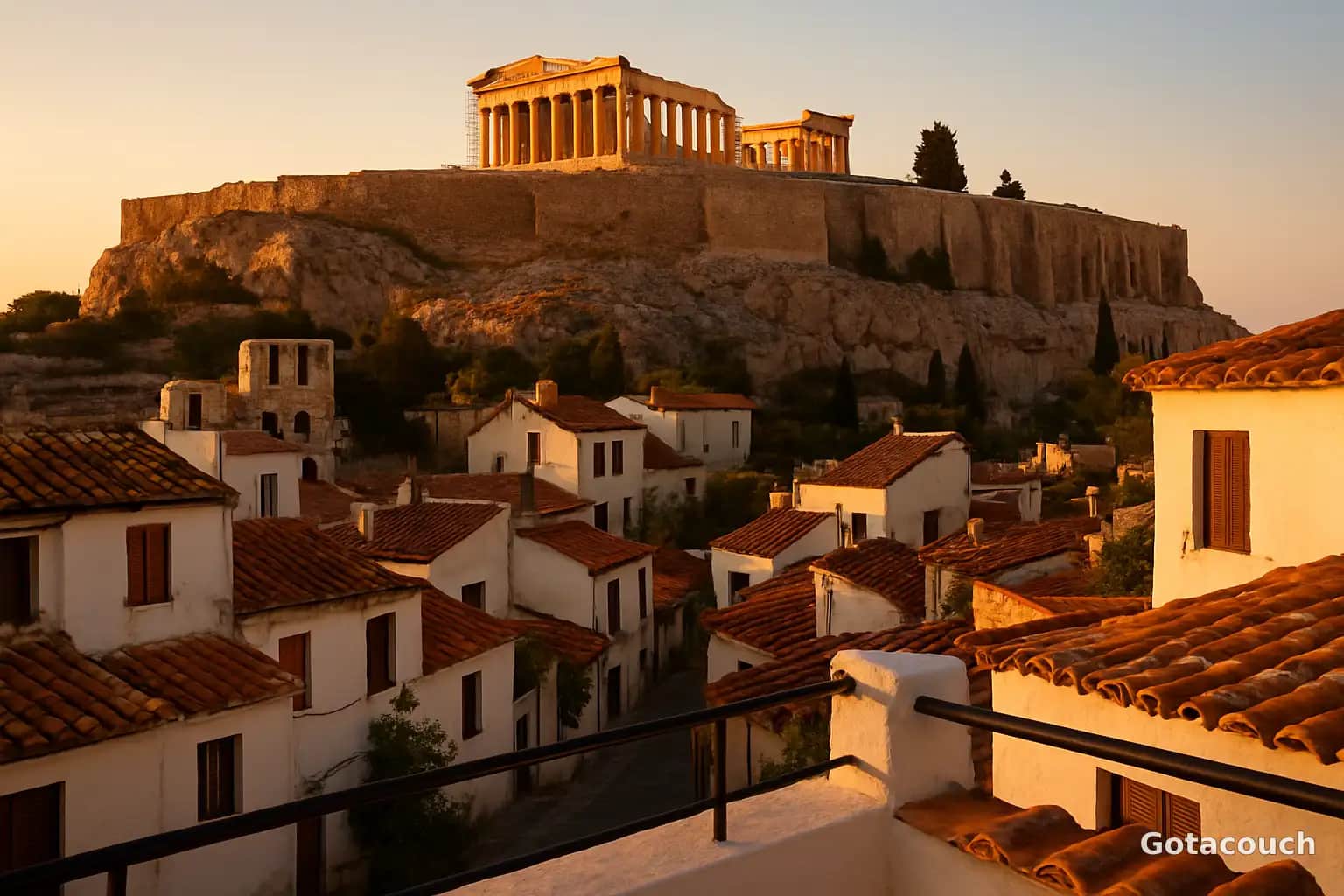
Athens rarely reveals itself in a single glance. You climb a marble staircase worn smooth by 2,500 years of footsteps, and the Parthenon appears against the sky like a promise the city has somehow kept. But turn a corner behind the Acropolis and you find yourself in a village of Cycladic cottages, or on a graffiti-lined street where students argue philosophy over frappé, or at a butcher's stall shouting prices in a market that has fed the city since the 1800s. This layering — ancient stone, Byzantine chapel, Ottoman lane, neoclassical façade, all stacked into the same city block — is exactly what makes Athens fascinating for travelers who want more than a checklist of ruins.
A City Built in Layers: From Pericles to the Modern Capital
Athens is widely regarded as the birthplace of Western democracy and philosophy, and its golden age arrived in the 5th century BC under Pericles, when the great monuments of the Acropolis were raised. What followed was centuries of transformation: Roman rule, the Byzantine era, then nearly four hundred years under Ottoman administration, before Athens became the capital of an independent modern Greece in 1834. Walk through the city center today and you can feel all of it at once — the urban fabric superimposes ancient, Byzantine, Ottoman and neoclassical periods, sometimes within the same street.
The Acropolis archaeological site has been a UNESCO World Heritage Site since 1987, and the Acropolis Museum, opened in 2009, houses the finds unearthed on the hill, offering context that the ruins alone can't provide. Beyond the Parthenon itself, the Ancient Agora — once the civic and commercial heart of classical Athens — the Roman Agora, Hadrian's Library, and the towering remaining columns of the Temple of Olympian Zeus all sit within walking distance of one another, letting you trace centuries of history in a single afternoon.
Neighborhoods That Tell Different Stories
What sets Athens apart from a purely monumental city break is how distinct its neighborhoods feel from one another, often just a few streets apart.
Plaka and Anafiotika
Plaka, the historic quarter at the foot of the Acropolis, is a maze of neoclassical lanes largely closed to traffic — charming, if unapologetically touristic, with souvenir sellers on nearly every corner. Slip into Anafiotika, though, and the mood shifts entirely: this tiny enclave of whitewashed, Cycladic-style houses was built by workers from the island of Anafi in the 19th century. Car-free and almost impossibly quiet, it feels like a village transplanted into the capital.
Psiri and Exarchia
Once a district of craftsmen, Psiri has become a lively hub of bars, tavernas and street art, buzzing after dark and popular with Athenians rather than tour groups. Exarchia, the student and alternative quarter, offers independent bookshops, unpretentious cafés and murals with a strong political identity rooted in anarchist movements. It's worth checking the current social climate before visiting, as occasional demonstrations occur here — but approached respectfully, it's one of the most authentic slices of contemporary Athenian life.
Kolonaki and Kerameikos
For a different register entirely, Kolonaki, at the foot of Mount Lycabettus, is Athens' upscale district of boutiques, galleries and cafés favored by the city's bourgeoisie. On the opposite end of the spectrum, Kerameikos, the ancient cemetery, remains calm and largely bypassed by tour groups — a peaceful counterpoint to the crowds around the Acropolis.
Eating and Shopping Like a Local
Greek gastronomy is built around sharing. Mezedes are meant to be ordered in quantity and passed around the table in tavernas and ouzeries, typically alongside ouzo or retsina, the resinated wine that remains a specialty of the Attica region. For something quicker, souvlaki, gyros and koulouri (sesame-crusted bread rings) are the everyday street food of choice, especially around Monastiraki and Psiri, both known for their mezedopolia.
For a genuine slice of daily Athenian life, head to the Varvakeios central market on Athinas Street, which has supplied the city with meat, fish, feta, olives and dried herbs since the 19th century. Each neighborhood also hosts its own weekly open-air producers' market, the laiki agora — ask your host which day applies to your area, since schedules vary by district, and it's worth double-checking exact hours with the municipality before heading over.
Beyond the City: Day Trips Worth the Effort
Athens is also a superb base for exploring further afield. Cape Sounion, about an hour south by road, is famous for watching the sunset from the Temple of Poseidon. Delphi, roughly two to two and a half hours northwest, deserves a full day given the scale of its archaeological site. Closer to the coast, the Saronic Gulf islands — Aegina, Poros, Hydra and Spetses — are reachable by fast ferry from Piraeus; car-free Hydra is a particular favorite for a slower-paced escape. History lovers can also combine Nafplio, Epidaurus and Mycenae in the nearby Peloponnese, while the Meteora monasteries, though further away, are worth the two-day trip with an overnight stay.
When to Go and How to Get Around
Spring (April to June) and autumn (September to early November) offer the most comfortable conditions for exploring the city on foot, avoiding both summer heat and the peak crowds that push prices up in tourist areas. Athens runs an integrated transport network — a three-line metro, buses, trams and trolleybuses — managed by the city's public transport authority. The metro connects Eleftherios Venizelos International Airport to the city center at Syntagma in about 40 minutes, using a specific airport ticket priced higher than a standard urban fare. The Port of Piraeus, main gateway for ferries to the islands, is easily reached via metro Line 1. If you'd rather take a taxi from the airport, a fixed fare typically applies, though it's worth reconfirming the current rate before you travel.
Practical Tips for a Smooth Stay
- Greece uses the euro; Athens remains generally more affordable than many Western European capitals, though prices rise in tourist zones and during high season.
- A tip of around 5 to 10% is customary, though not obligatory.
- Stay alert for pickpockets in the metro and in heavily touristed spots like Monastiraki, Syntagma and Plaka, and use extra caution at night around Omonia.
- Greece is part of the Schengen area: EU citizens can travel with a valid ID card, while non-EU nationals need a valid passport and should check visa requirements in advance.
- If planning an island day trip, check ferry schedules and fares directly with the operating companies before booking.
An Ending That Feels Like a Beginning
Athens is a city where a 25-century-old temple can share a skyline with student murals, where a fish market can sit blocks from a museum built to house treasures once buried underground. It rewards travelers who wander off the main axis between Syntagma and the Acropolis, who linger over mezedes instead of rushing between monuments, who let each neighborhood tell its own chapter of the story. Whatever your itinerary, Athens tends to leave visitors already planning their return.
Articles to discover

Auckland, City of Volcanoes and Sails: Where Māori Heritage Meets the Pacific Soul of New Zealand
September 19, 2026 at 8:06 PM

Amsterdam Beyond the Canals: Cycling Through Neighborhoods, Markets and the Dutch Art of Everyday Life
September 19, 2026 at 8:55 AM

Accra, the Ghanaian capital that carried Africa's independence: Jamestown, Osu and the Ga soul
September 5, 2026 at 12:58 AM

Seoul, a City of Two Faces: Royal Palaces, Futuristic Neon and Hallyu Culture Along the Han
September 2, 2026 at 8:05 AM
Fez, the Idrisid City Where You Learn to Slow Down: A Millennial Medina, Living Craftsmanship and Andalusian Flavors
September 1, 2026 at 8:04 PM
Madrid, a Capital of Two Speeds: Between Art, Bustling Markets, and Spanish Popular Traditions
September 1, 2026 at 8:04 AM
Comments
Log in to leave a comment.
No comments yet.