Chiang Mai Within Its Moats: Lanna Heritage, Misty Mountains and the Slow Rhythm of Northern Thailand
October 14, 2026 at 3:17 PM · GotaNomad
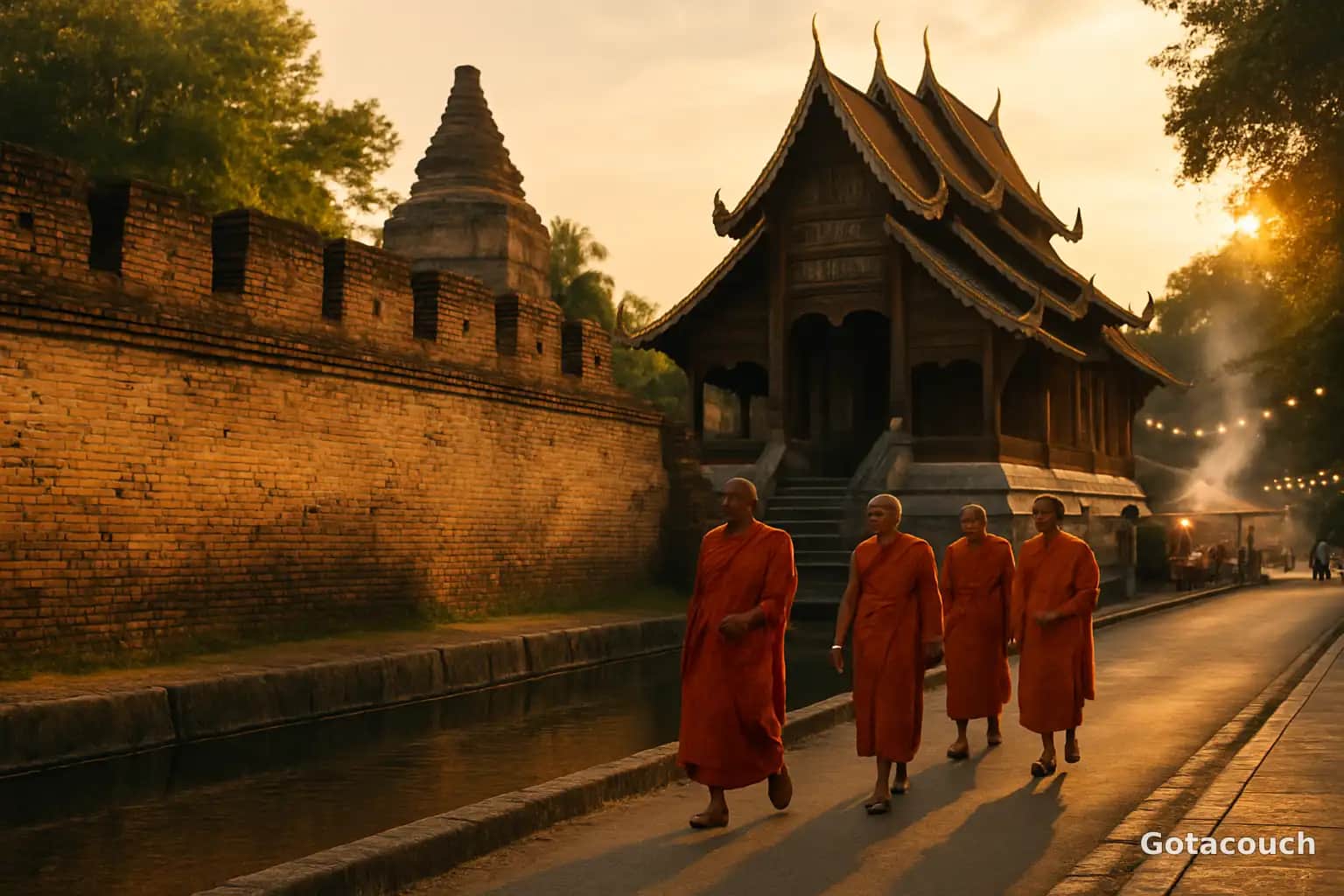
There is a particular stillness to Chiang Mai at dawn, when orange-robed monks make their quiet rounds past brick ramparts that have stood since the 13th century. Unlike the glass towers of Bangkok a few hours south, Chiang Mai wears its history close to the skin: a square of ancient walls, a ring of murky green moats, and a rhythm of life that still seems to follow the hills rather than the clock. This is a city built not for conquest but for contemplation — and that spirit remains remarkably intact today.
A Kingdom of a Million Rice Fields
Chiang Mai was founded in 1296 by King Mangrai as the capital of the Lanna kingdom, whose name translates roughly as the "kingdom of a million rice fields." For centuries, Lanna thrived as an independent cultural and political power across northern Thailand, developing its own script, architecture and Buddhist traditions before gradually being absorbed into the kingdom of Siam. That layered identity — distinct from central Thai culture, yet woven into the national story — is still visible everywhere: in temple carvings, in the northern dialect you'll hear in markets, and in a cuisine that owes as much to Burma and Yunnan as it does to Bangkok.
The old city's original square layout survives almost perfectly, bordered by moats and fragments of brick fortifications that once protected the royal capital. Walking or cycling this perimeter is one of the simplest ways to feel the shape of history beneath your feet.
Temples That Tell the Lanna Story
Inside the old city walls, roughly thirty temples compete gently for attention, each a chapter of the same unfolding story. Wat Phra Singh, one of the most revered temples in the city, draws a steady stream of devotees and visitors alike. Nearby, Wat Chedi Luang centers on a massive stupa dating from the 14th-15th century, partially collapsed by earthquake and time, its weathered brick somehow more moving than a pristine monument would be.
Above the city, perched on a forested hillside, Wat Phrathat Doi Suthep is the region's most visited religious and historical site. Its founding legend — tied to a sacred relic said to have guided the temple's location — gives the climb up its naga-flanked staircase an added sense of pilgrimage, especially at sunset when the city below begins to glitter through the haze.
Neighborhoods Beyond the Walls
Step outside the moats and Chiang Mai fragments into distinct personalities. Nimmanhaemin, known simply as Nimman, has become the city's creative hub: a grid of specialty cafés, coworking spaces, design boutiques and the Maya shopping complex, popular with digital nomads and young Thai professionals. Just next door, Santitham offers a refreshing contrast — a genuinely residential quarter wedged between the old city and Nimman, where locals shop at street-corner noodle stalls rather than artisanal coffee bars, and where visitors who wander in often feel like they've found the "real" Chiang Mai almost by accident.
On the eastern bank of the Ping River, the Wat Ket / Riverside district preserves rows of century-old shophouses along Thanon Charoen Rat, a heritage streetscape that hints at the city's past as a trading post linking the hills to the Siamese lowlands. In the old city's southwest corner, the Wua Lai quarter has been the traditional home of Chiang Mai's silversmiths for generations — a place where, with a little curiosity, travelers can still watch artisans hammering intricate repoussé silverwork rather than simply browsing souvenir shelves.
Markets, Classes and Local Rituals
No visit feels complete without a morning at Warorot Market (Kad Luang), the city's historic covered market and a reference point for fresh produce, northern spices and Thai snacks — it's also where songthaews depart for mountain villages like Mae Kampong. On weekends, the streets themselves become markets: the Sunday Walking Street along Ratchadamnoen Road fills with Lanna handicrafts, street food stalls and impromptu performances, while the Saturday Night Market on Wualai Road channels the neighborhood's silversmithing heritage into a livelier evening affair. (Schedules shift occasionally, so it's worth confirming times locally before setting out.)
For a deeper dive into the region's culinary logic, small-group Thai cooking classes are widely available and genuinely worthwhile — most begin with a market visit to shop for ingredients before heading to a home kitchen or farm setting to cook.
The Flavors of the North
Chiang Mai's food culture distinguishes itself firmly from the rest of Thailand. The emblematic dish is khao soi, a coconut curry noodle soup that reflects clear Burmese influence layered onto Lanna tradition — crispy noodles on top, soft ones below, a tangle of lime, pickled mustard greens and shallots on the side. Equally essential is sai oua, a herb-and-spice-packed grilled sausage, along with fiery northern relishes like nam prik noom and nam prik ong, both built for scooping with sticky rice. Eating your way through Chiang Mai is less about fine dining and more about chasing smoke from a market grill.
Into the Hills: Day Trips and Slow Villages
Chiang Mai's setting among forested mountains makes it a natural base for exploring beyond the city. Mae Kampong, a mountain village reachable via songthaew from Warorot Market, has become a model for community-based ecotourism, with homestays offering a direct, low-key way to experience rural northern life. Further afield, Doi Inthanon — Thailand's highest peak, roughly 1.5 to 2 hours by road — rewards visitors with cooler air, waterfalls and hiking trails through cloud forest. Closer in, around an hour to ninety minutes away, Chiang Dao offers dramatic limestone caves and a quieter mountain town feel. Those with more time often stretch toward Pai, a laid-back hill town three to four hours away via a famously winding road — a trip best suited to travelers who enjoy switchbacks as much as destinations.
When to Go
The cool, dry season from November to February is generally considered the most comfortable time to visit, with clearer skies and pleasant temperatures for temple-hopping and hiking. March and April often bring the region's seasonal burning period, when agricultural fires can affect air quality noticeably — it's worth checking current conditions before planning a trip around these months. The rainy season, from June to October, makes some mountain trails slippery but rewards visitors with lush green landscapes and noticeably thinner crowds, a trade-off worth considering for travelers who don't mind the occasional downpour.
Practical Notes for Your Stay
Two to three days are generally enough to explore the city itself, while four to six days allow for one or two excursions, such as combining Doi Suthep with Doi Inthanon, or adding a round trip to Pai. French travelers typically benefit from visa-free entry for short tourist stays, though conditions change periodically, so it's worth checking directly with the Thai embassy or consulate before departure, alongside up-to-date safety advice from official government travel resources.
Getting around is part of the experience: shared red songthaews remain a wonderfully local way to move through the city, often more interesting than booking a ride through an app like Grab, which is also widely available alongside tuk-tuks. Renting a scooter is common for reaching outlying temples and villages, but helmets are mandatory, local traffic rules differ meaningfully from Europe, and appropriate insurance is strongly recommended. Watch too for scooter rental scams involving excessive deposits, as well as the usual pickpocketing risks and dubious tour offers found in any popular destination — Chiang Mai is broadly considered safe, but ordinary vigilance still applies. On the upside, it remains one of Southeast Asia's more affordable cities, with a cost of living well below Western Europe, leaving more room in the budget for that extra bowl of khao soi, or one more night in the mountains.
Chiang Mai doesn't rush to impress you. It waits, quietly, behind its moats and misty hills, until you slow down enough to notice.
Articles to discover
Bangkok Off the Postcard: Canals, Chinatown Alleys and Temple Mornings Along the Chao Phraya
October 14, 2026 at 2:15 PM
Copenhagen on Two Wheels: Canals, Hygge and the New Nordic Spirit of Denmark's Capital
October 15, 2026 at 11:18 AM
Cartagena de Indias: Walls Built Against Pirates, a Heart Beating to Afro-Caribbean Rhythm
October 14, 2026 at 3:07 PM
Cape Town Between Two Oceans: Layers of History, Colour and Cuisine Beneath Table Mountain
October 14, 2026 at 2:57 PM
Buenos Aires Block by Block: Tango Roots, Immigrant Dreams and the Rituals of Porteño Life
October 14, 2026 at 2:48 PM

Budapest, City of Two Souls: How Buda and Pest Became One Danube Capital
October 14, 2026 at 2:32 PM
Comments
Log in to leave a comment.
No comments yet.