Istanbul, straddling two continents: a journey through a megacity that reads like a history book
August 19, 2026 at 3:38 AM · Compte supprimé
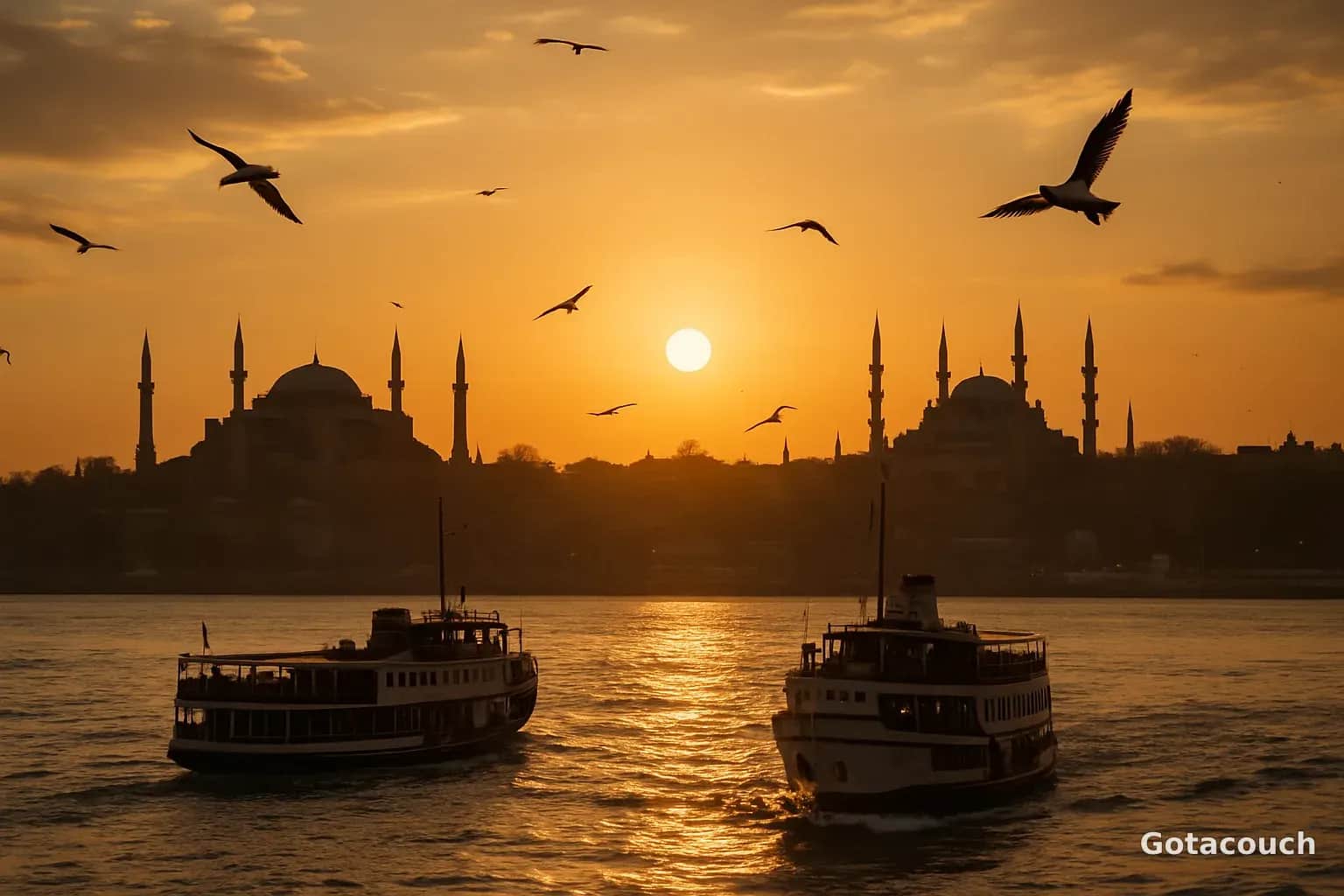
Few cities in the world are capable of summing up, within the same neighborhood, more than sixteen centuries of history. Istanbul is one of them. Byzantium at its origins, Constantinople for more than a thousand years, Istanbul since 1930: the city has changed its name three times and its civilization twice, without ever giving up its destiny as a crossroads. Straddling the Bosphorus strait, it connects Europe to Asia via ferries that cross the water in just a few minutes, and this is perhaps, more than its monuments, what makes it unique: you can have breakfast on one continent and dinner on the other, all without ever leaving the same city.
With more than 18.6 million international visitors welcomed in 2024, up from 17.4 million the previous year, Istanbul confirms its status as Turkey's most popular destination, accounting on its own for roughly a third of the country's foreign arrivals. But behind these impressive figures lies a city best discovered at eye level with its residents, in its centuries-old hammams, its neighborhood markets and its everyday ferries.
A history with three faces
It all begins in 330, when Emperor Constantine made the ancient city of Byzantium the capital of his empire. After forty days of celebrations, the city was renamed Constantinople and became the beating heart of the Eastern Roman, then Byzantine, empire for more than a millennium. The turning point came on May 29, 1453: Mehmed II rode into Hagia Sophia on horseback, which was immediately converted into a mosque, marking both the end of the Byzantine empire and the rise of Ottoman power. It was only in 1930, under the young Turkish Republic, that the city officially took the name Istanbul, even though the country's political capital had already moved to Ankara in 1923.
This succession of empires has left behind a unique urban skyline, now listed as a UNESCO World Heritage Site, where Byzantine domes and Ottoman minarets together shape the horizon.
Neighborhoods with distinct identities
Istanbul isn't so much visited as it is crossed neighborhood by neighborhood, each with its own atmosphere.
- Sultanahmet, the historic heart, concentrates the major monuments and is easily explored on foot or by tram, at the cost of sometimes heavy tourist crowds.
- Eminönü, right next door, charms with its views over the Golden Horn and its chaotic, flavorful spice market.
- Beyoğlu and Galata, with their iconic tower and İstiklal Avenue, embody bohemian, nocturnal Istanbul.
- Karaköy blends trendy nightlife with contemporary art around the Istanbul Modern museum.
- Balat and Fener, among the oldest neighborhoods in the city, offer colorful houses, Orthodox churches and synagogues in an atmosphere that is both historic and alternative.
- Kadıköy and Moda, on the Asian shore, reveal a distinctly local vibe, far from the tourist frenzy.
- Üsküdar, often mistakenly seen as conservative, actually embodies the full diversity and historical depth of Istanbul.
The monuments that tell the city's history
Hagia Sophia remains the most striking monument, a direct witness to the two great turning points in the city's history. Right across from it, the Blue Mosque, built in the 17th century under the reign of Sultan Ahmed I, owes its nickname to the thousands of Iznik tiles adorning its interior; its dome rises to 43 meters and 260 windows flood the space with light, all framed by six minarets.
Topkapi Palace, the former residence of the sultans, brings together mosques, hammams and even a hospital within a vast complex, while Dolmabahçe Palace impresses with kitchens once capable of feeding up to 4,000 people. Underground, the Basilica Cistern, dug as early as 542 to supply Constantinople with water, stretches over 140 meters in an almost otherworldly atmosphere.
Finally, it's impossible to miss the Grand Bazaar, whose history dates back to 1455 when Mehmed II had the first covered bazaar built near his palace. Today, this labyrinth spans more than 45,000 square meters, contains around 3,600 shops spread across 64 streets and 22 gates, and employs several thousand merchants daily.
Experiences for encountering the city differently
Beyond its monuments, Istanbul is lived through its rituals. The hammam, for example, was never merely a place for washing: it has historically been a space for social life where people exchanged news and strengthened community ties, a tradition still upheld today in historic establishments such as the Çemberlitaş hammam or the Cağaloğlu hammam.
A cruise on the Bosphorus, or simply a round-trip public ferry ride to Üsküdar or Kadıköy, offers an inexpensive way to grasp the city's geography and rhythm of life. For a more contemplative experience, Eyüp hill and its Pierre Loti café offer a panoramic view over the Golden Horn, while a whirling dervish performance, inherited from the Sufi order founded by Jalal al-Din Rumi in the 13th century, can be discovered at venues such as the Hodjapasha Culture Center.
Street food, the soul of everyday life in Istanbul
Istanbul is as much to be tasted as it is to be visited. Mornings often begin with a simit, that sesame ring crunchy on the outside and soft on the inside, paired with a glass of tea. In Eminönü, considered the city's street food capital, floating boats grill mackerel and sea bass to prepare balık ekmek, a fish sandwich best enjoyed while watching boats glide across the Golden Horn. Along the way, rice-stuffed mussels, midye dolma, are savored with a squeeze of lemon, typically in the evening.
Kadıköy market, on the Asian shore, deserves a visit of its own: unlike the Grand Bazaar, it's an open-air commercial district where fruit, fish, olives and pastries mingle with street food stalls, in an atmosphere highly popular with locals themselves.
The lesser-known faces of Istanbul
Far from the crowds of Sultanahmet, Balat reveals its colorful houses, its old Ahrida Synagogue and its independent cafés. The Asian shore, often overlooked by hurried visitors, nonetheless deserves lingering time, particularly around Leander's Tower in Üsküdar, from where you can take in Topkapi Palace, Hagia Sophia, the Blue Mosque and the Galata Bridge all in a single glance. Further out, the car-free island of Burgazada invites bike rides and secret coves, far from the urban bustle.
Easy escapes from the city
To extend your stay, the Princes' Islands are among the most popular excursions: Büyükada can be reached in 75 to 120 minutes by ferry from several piers in the city, with frequent departures allowing for a same-day round trip. Bursa, the first Ottoman capital, can be reached in about 90 minutes by fast ferry to Mudanya, while Şile, on the Black Sea coast, appeals to fans of coastal hiking. These excursions are best planned in spring or autumn, when temperatures remain mild and the crowds thinner.
When to go?
Spring, between April and June, and autumn, between September and October, offer the most pleasant conditions, with maximum temperatures generally ranging between 16 and 25°C. May, with temperatures between 13 and 23°C, is often cited as the ideal period, just before the arrival of the summer crowds. Summer, marked by long days and heat that can approach 30°C, remains very busy, while winter sees temperatures sometimes drop close to 0°C.
How long should you stay?
For a thorough first discovery, plan on three to five days. Two to three days are enough to explore Sultanahmet in depth, ideally devoting a full day to it given how concentrated the sites are. With four to five days, you can add Beyoğlu, Galata, a Bosphorus cruise and a foray into the Asian shore. Beyond a week, Balat, the Princes' Islands and an excursion to Bursa round out the picture nicely.
Practical tips for a smooth trip
- Get an Istanbulkart as soon as you arrive: it gives access to a modern, clean and safe public transport network (metro, tram, funicular, ferries).
- On the T1 tourist tram line, which is often crowded, stay alert for pickpockets.
- For getting around by car, favor apps like BiTaksi or Uber rather than taxis hailed on the street.
- Public ferries crossing the Bosphorus are safe, affordable, and offer one of the most beautiful ways to discover the city.
- Tap water is not drinkable: opt for bottled water, which is very affordable.
- Beware of the classic shoeshine scam, where the shiner drops his brush to strike up a conversation.
- Double-check which of the two airports (Istanbul Airport or Sabiha Gökçen) serves your flight in order to plan your transfer accordingly.
A city to live in, more than to check off a list
Istanbul resists any hurried visit. You can check off Hagia Sophia, the Blue Mosque and the Grand Bazaar in a few hours, but you truly understand the city only by lingering in a neighborhood hammam, sharing tea with a shopkeeper in Kadıköy, or watching the sun set from a ferry between the two shores. This is precisely the spirit that GOT A COUCH? champions — staying with locals means gaining access to that other Istanbul, the one whispered in the alleys of Balat or along the docks of Üsküdar, long after the tour groups have left.
Articles to discover
Athens Neighborhood by Neighborhood: Marble Ruins, Cycladic Alleys and Rooftop Ouzo Beneath the Acropolis
September 21, 2026 at 12:20 PM
Auckland, City of Volcanoes and Sails: Where Māori Heritage Meets the Pacific Soul of New Zealand
September 19, 2026 at 8:06 PM
Amsterdam Beyond the Canals: Cycling Through Neighborhoods, Markets and the Dutch Art of Everyday Life
September 19, 2026 at 8:55 AM
Accra, the Ghanaian capital that carried Africa's independence: Jamestown, Osu and the Ga soul
September 5, 2026 at 12:58 AM
Seoul, a City of Two Faces: Royal Palaces, Futuristic Neon and Hallyu Culture Along the Han
September 2, 2026 at 8:05 AM
Fez, the Idrisid City Where You Learn to Slow Down: A Millennial Medina, Living Craftsmanship and Andalusian Flavors
September 1, 2026 at 8:04 PM
Comments
Log in to leave a comment.
No comments yet.