Montreal, the French-Speaking Metropolis Best Lived at Neighborhood Level: Districts, Markets and Green Alleys
August 19, 2026 at 3:24 AM · Compte supprimé · Updated on September 7, 2026 at 12:19 AM
A city born from a missionary project that became a global crossroads
It all began in 1642, when a group of French settlers landed on an island in the Saint Lawrence River, nearly 265 kilometers from Quebec City, with a goal that seems almost surreal today: founding a Catholic mission dedicated to converting Indigenous peoples. The city was meant to be called Ville-Marie, in honor of the Virgin Mary, under the leadership of Paul de Chomedey, Sieur de Maisonneuve. Historian Gustave Lanctot saw it as a unique case in the history of cities: a birth whose sole purpose was to honor God, carried out by a society founded in France, the Société des Messieurs et Dames de Notre-Dame de Montréal, which was granted the entire island as a seigneury.
The initial religious calling quickly gave way to the fur trade, which turned Montreal into a bridgehead between the French and Indigenous peoples, and later into a full-fledged North American metropolis. Today, the city counts more than 1.8 million inhabitants within its municipal limits, where French remains the official and predominantly spoken language, alongside English and an impressive number of other languages. Montreal is in fact considered Canada's most trilingual city, largely thanks to a population shaped by immigration that naturally moves between French, English and a mother tongue. With more than 170,000 students, it also ranks second among North American metropolises for the number of university students per capita, which explains the young, creative energy running through the city.
Le Plateau, Mile End and beyond: neighborhoods to live in rather than just visit
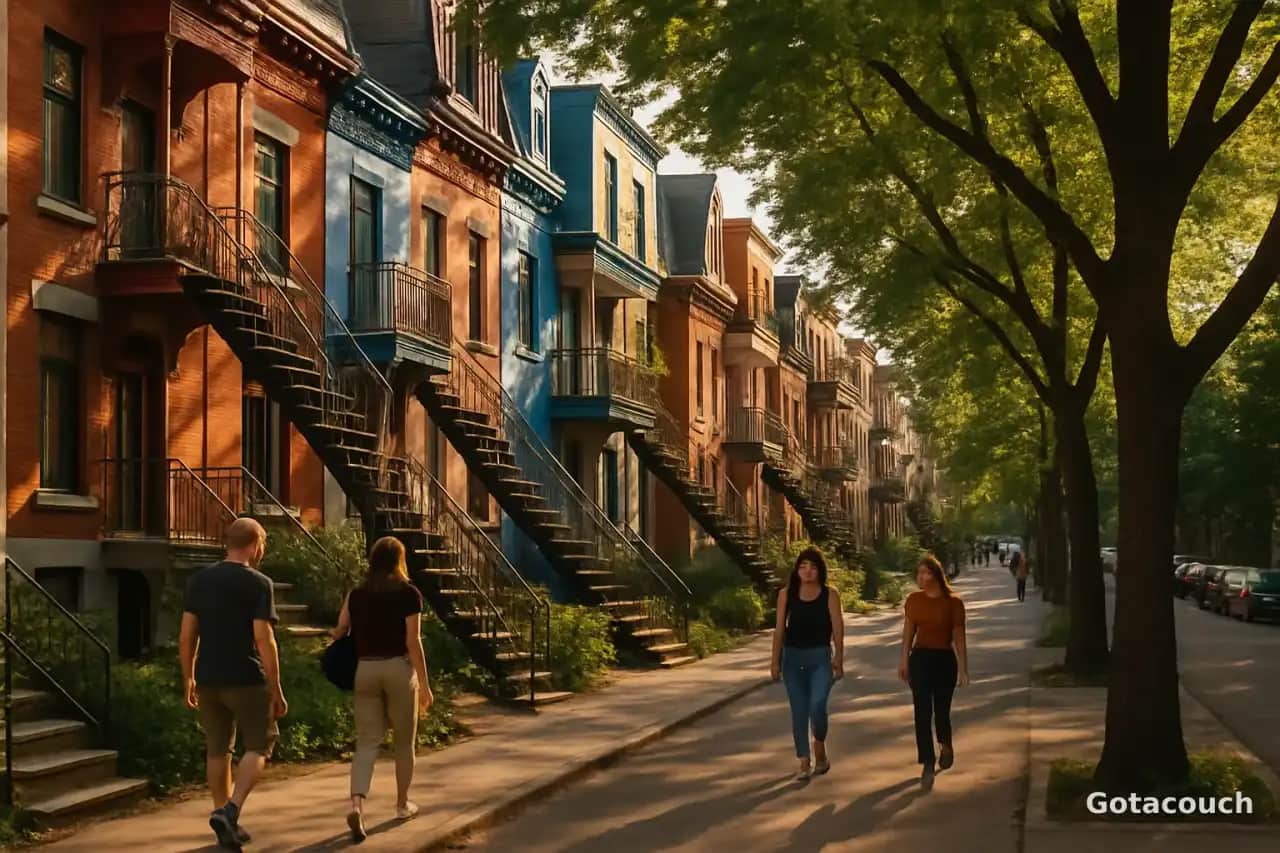
It is impossible to understand Montreal without walking through its neighborhoods, each with a strong personality of its own. Plateau-Mont-Royal, inhabited since the late 1700s, remains one of the city's liveliest districts, instantly recognizable thanks to its spiral staircases clinging to the facades and one of the highest urban densities in all of Canada. In summer, Mont-Royal Avenue and Duluth Avenue, with their brick paving, turn pedestrian-only and become a true open-air living room.
Right next door, Mile End charms visitors with its independent cafés and design boutiques, while Old Montreal unrolls its history-laden cobblestone streets. Further out, Little Italy, Villeray, Outremont, Westmount and Hochelaga each offer completely different atmospheres, ranging from cultural heritage to upscale residential enclaves and working-class life. This is precisely the spirit GOT A COUCH? loves to encourage: don't settle for the touristic center, but let a local host guide you toward the neighborhood that truly reflects them.
On Mont Royal and in Old Montreal: the landmarks that tell a story
Mont Royal Park remains, without question, the city's most famous green lung; in 2026, it will even celebrate its 150th anniversary. There you'll find the monument to Sir George-Étienne Cartier, a spectacular work over 30 meters high by William Hill, whose terrace is guarded by four lions and topped with a pyramidal column flanked by 18 bronze allegorical statues.
Not far away, Saint Joseph's Oratory, founded in 1904 by Blessed Brother André, concentrates history, culture and architecture all in one place. Sainte-Catherine Street, stretching 11 kilometers, ranks among Canada's longest commercial thoroughfares. In the Hochelaga area, the Olympic Stadium, the Biodôme and the Botanical Garden form a dense cultural and scientific hub, while Maison Saint-Gabriel, in Pointe-Saint-Charles, built around 1660, bears witness to the life of the very first French settlers in America.
Markets, green alleys and encounters: local spirit above all
It is perhaps in its markets that Montreal reveals itself best. Jean-Talon Market, open year-round, ranks among the largest open-air markets in North America and remains a favored spot both for chatting with passionate producers and for finding fresh products. Atwater Market, with its "Pôle des Saveurs" (Flavor Hub), delights food lovers just as much.
To step off the beaten path, head to the green alleys of Le Plateau, marked by discreet signs. They reveal a hidden world of leafy paths and artistic projects that express the neighborhood's unique personality, far from the usual tourist circuits. This is exactly the philosophy championed by the local tourism office, which invites visitors not to think of themselves as tourists, but as one of the locals for the duration of their stay — an invitation that resonates deeply with the GOT A COUCH? spirit, where staying with a local host becomes a gateway into this neighborhood life.
Montreal's gastronomy: poutine, bagels and smoked meat
Montreal ranks among North America's best food cities, with a unique blend of French traditions, Jewish heritage and Quebecois innovation. There's no avoiding poutine, served in every possible way: La Banquise, an institution in Plateau-Mont-Royal open 24 hours a day, offers more than 30 different versions, while Au Pied de Cochon serves up a generous variation topped with foie gras.
Another great classic: the Montreal bagel, whose preparation pits two historic Mile End bakeries against each other, St-Viateur Bagel and Fairmount Bagel, in a rivalry as delicious as it is friendly. Smoked meat, a specialty rooted in the city's Jewish heritage, completes this essential culinary trio, best enjoyed at one of downtown's iconic delis.
Festivals and culture: a city with a rhythm all year round
Festivals are a cornerstone of Montreal life: jazz, comedy, avant-garde dance, even poutine — for every season and every art form, the city has its own dedicated event. From illuminated winter festivals celebrating art, food and outdoor sports to international rhythms and circus performances in the height of summer, these gatherings bring locals and visitors together in the same buzz of excitement. The Festival International de Jazz de Montréal and the Just for Laughs comedy festival rank among the most iconic, alongside the Festival TransAmériques, founded in 1985, which has always carried a determination to push cultural boundaries by bringing together the best of contemporary dance and theater.
When to visit Montreal
The most pleasant period runs from June to August, when the climate naturally draws crowds eager to enjoy the sunshine and major cultural festivals. This high summer attendance, however, means a higher travel budget, both for flights and accommodation. For travelers who prefer a balance between mild weather and calmer crowds, May offers pleasant temperatures, generally between 15 and 20°C, while March remains cool and April is often marked by slush — two periods best avoided to fully enjoy the city.
Beyond the island: Laurentides, Cantons-de-l'Est and Montérégie
Extraordinary experiences and spectacular landscapes await just fifteen minutes to two hours' drive from Montreal: the picturesque villages of Cantons-de-l'Est, the peaks of the Laurentides, the flavors of Montérégie, the forests of Lanaudière, and Laval with its varied attractions. Montérégie, to the southeast, is renowned for its vineyards, maple groves and above all its orchards, while Laval, just to the north, makes it easy to combine entertainment, culture and nature in a single getaway.
Practical tips for planning your stay
The Société de transport de Montréal's metro network, paired with the rechargeable OPUS card, allows for efficient travel between central neighborhoods such as Le Plateau or Old Montreal. As for language, there's nothing to worry about: the trilingual city welcomes French speakers and English speakers with equal ease. Montreal is generally considered a safe city for travelers, with the usual precautions of any major metropolis still applying. However, you should plan carefully for the extreme temperature swings between hot, humid summers and harsh, snowy winters when packing your bags.
A city growing more popular year after year
The numbers confirm this rising appeal: in 2024, Montreal recorded a nearly 7% increase in tourist numbers compared to the previous year, with around 11 million visitors. Canadian and American visitors grew by 6% and 11% respectively, while Chinese visitors surged by 46%, even in the absence of direct flights between China and Montreal. Of these 11 million visitors, 7.5 million came from Quebec and the rest of Canada, 2 million from the United States, with international tourists representing 15% of the market. The hotel occupancy rate reached 71.2%, and tourism-generated spending topped 6 billion dollars. Perhaps the most telling sign: 93% of visitors reported being satisfied with their stay in 2024, with notable increases among South Korean, North African and Japanese travelers. All the more reason to come see for yourself, staying with a local host, why this French-speaking city of North America continues to captivate so many.
Articles to discover
Athens Neighborhood by Neighborhood: Marble Ruins, Cycladic Alleys and Rooftop Ouzo Beneath the Acropolis
September 21, 2026 at 12:20 PM
Auckland, City of Volcanoes and Sails: Where Māori Heritage Meets the Pacific Soul of New Zealand
September 19, 2026 at 8:06 PM
Amsterdam Beyond the Canals: Cycling Through Neighborhoods, Markets and the Dutch Art of Everyday Life
September 19, 2026 at 8:55 AM
Accra, the Ghanaian capital that carried Africa's independence: Jamestown, Osu and the Ga soul
September 5, 2026 at 12:58 AM
Seoul, a City of Two Faces: Royal Palaces, Futuristic Neon and Hallyu Culture Along the Han
September 2, 2026 at 8:05 AM
Fez, the Idrisid City Where You Learn to Slow Down: A Millennial Medina, Living Craftsmanship and Andalusian Flavors
September 1, 2026 at 8:04 PM
Comments
Log in to leave a comment.
No comments yet.